This section explores the Catholic understanding of sainthood and how the saints act and intercede for others.
We will also have a look at common devotional practices, including the Rosary.
You are here: » Christianity in View » Introduction to Roman Catholicism » The Saints
Page Navigation:
What is a Saint ? | What is Veneration ? | The Communion of Saints | Mary, The Blessed Virgin | The Rosary | Marian Apparitions | Doctors of the Church
 What is a ‘Saint’ ?
In Catholic theology, the term ‘Saint’ is reserved for those individuals who have led a holy and exemplary life and have now entered Heaven. The process of becoming a Saint is termed canonization and the first known canonization was of Ulric of Augsburg in 973. Within the Catholic Church there exists a special department (The Congregation for the Causes of Saints), which oversees the whole process. They would thoroughly investigate the life of the individual, checking for orthodox belief and any miracles claimed as a result of their intercession. The appearance of miracles is taken that the person is now in heaven and can intercede for us as part of the ‘Communion of Saints’ (see below).
Once the Congregation has completed their work, the Pope may issue a decree declaring the person to be ‘Blessed’, that is, beatified. Once beatified, another miracle is then required to allow the Pope to declare the individual a saint. A feast day may then be allocated and veneration of the saint encouraged. Examples include:
- 28 August – St. Augustine of Hippo (354-430)
- 4 October – St. Francis of Assisi (1182-1226)
What is ‘Veneration’ ?
Veneration of the saints is the way in which the Catholic church honours and respects those who it regards as deserving of such action. Catholic theology draws a clear distinction between veneration and worship. Three Greek terms illustrate this point:
- Latria (‘Worship’) – The adoration that is due to God alone.
- Dulia (‘Servitude’) – The respect given to the saints. Honouring the saints is seen is honouring God, because of his presence and holiness in their lives.
- Hyperdulia (‘Higher Servitude’) – The special veneration given to the Virgin Mary, on account of her role as Mother of Christ. Mary is also called the ‘Mother of God’ in the sense that the Son she bore was truly God and part of the Trinity of Father, Son and Holy Spirit.
Note: The term ‘Our Lady’ is widely used within the Church for Mary, paralleled by ‘Our Lord’ for Christ. For example: ‘Our Lady of Lourdes’.
Paragraph 50 of the Dogmatic constitution on the church, proclaimed by Pope Paul VI in 1964 at the Vatican II council, explains the Catholic thinking behind veneration:
“…The Church has always believed that the apostles and Christ’s martyrs who had given the supreme witness of faith and charity by the shedding of their blood, are closely joined with us in Christ, and she has always venerated them with special devotion, together with the Blessed Virgin Mary and the holy angels. The Church has piously implored the aid of their intercession. To these were soon added also those who had more closely imitated Christ’s virginity and poverty, and finally others whom the outstanding practice of the Christian virtues and the divine charisms recommended to the pious devotion and imitation of the faithful.”
The ‘Communion of Saints’
This term refers to the union of believers on Earth, in Heaven and also (in Catholic theology) those in Purgatory. All form part of the body of Christ.
Each group is identified by the following terms:
- Church Triumphant – The Saints in Heaven
- Church Militant – Those on earth
- Church Suffering (sometimes called Church Expectant) – Those in purgatory
Catholic belief indicates that those saints now in Heaven are able to intercede, not only for those on Earth, but also those in Purgatory. Their intercession is considered to be effective on account of their closeness to God. Also, those on Earth can intercede for those in Purgatory.
“We believe in the communion of all the faithful of Christ, those who are pilgrims on earth, the dead who are being purified, and the blessed in heaven, all together forming one Church; and we believe that in this communion, the merciful love of God and his saints is always attentive to our prayers.”
Paragraph 962, CCC.
Allied to the idea of saintly intercession is the concept of a Patron saint, i.e. a special kind of intercessor for a country, special situation or job. Examples include:
- St. Antony of Padua (c.1191-1231) – for lost articles.
- St. Francis of Assisi (1182-1226) – for Animals.
- St. Patrick (c.390-461) – for Ireland.
St. Isidore of Seville has been proposed as the patron saint of the Internet.
Mary, The Blessed Virgin
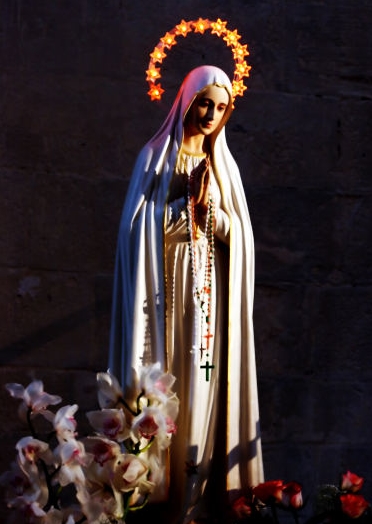
We noted above that Mary commands a special role in Catholic theology. From her position as the Theotokos (Greek: ‘God-Bearer’), she is seen as having special intercessory gifts and influence with her son. Marian devotion has increased in recent times, taking such forms as the Rosary and pilgrimages to Marian shrines (see articles below).
The Catholic church has proclaimed four Marian dogmas:
- The Immaculate Conception – In a papal encyclical Ineffabilis Deus (The Ineffable God) issued in 1854, Pope Pius IX proclaimed that:
“The most Blessed Virgin Mary was, from the first moment of her conception, by a singular grace and privilege of almighty God and by virtue of the merits of Jesus Christ, Saviour of the human race, preserved immune from all stain of original sin.”
The word ‘Immaculate’ derives from the Latin Macula, i.e. a mark or stain. To support this dogma, attention is drawn to Luke 1:28, in which the Angel Gabriel greets Mary with the words “Hail Mary, Full of Grace.” (Latin: Ave Maria, Gratia Plena.)
- The Assumption – First proclaimed in 1950 by Pope Pius XII in the encyclical Munificentissimus Deus (The generosity of God). This states that:
“…the Immaculate Mother of God, the ever Virgin Mary having completed the course of her earthly life, was assumed body and soul to heavenly glory.”
A distinction is drawn between the Ascension i.e. Christ rising to Heaven by his own divine power and Assumption, which happens through divine intervention. For example, the Old Testament includes the assumptions of Elijah (2 Kings 2:11) and Enoch (Genesis 5:24). The question of whether Mary actually died remains an open one within the church.
- The Perpetual Virginity of Mary – the Catholic Church holds as dogma that Mary was and is Virgin before, in and after Christ’s birth. The Biblical references to Christ’s “Brothers and Sisters” (Matthew 13:54-47) are understood to mean close relatives.
The deepening of faith in the virginal motherhood led the Church to confess Mary’s real and perpetual virginity even in the act of giving birth to the Son of God made man. In fact, Christ’s birth “did not diminish his mother’s virginal integrity but sanctified it.” And so the liturgy of the Church celebrates Mary as Aeiparthenos, the “Ever-virgin.”
Paragraph 499, CCC.
- Mary as the ‘Mother of God’ – This title was first given to Mary at the council of Ephesus in 431 and emphasises her role as the Mother of Christ, who is truly God and the second person of the trinity.
Called in the Gospels “the mother of Jesus,” Mary is acclaimed by Elizabeth, at the prompting of the Spirit and even before the birth of her son, as “the mother of my Lord,” In fact, the One whom she conceived as man by the Holy Spirit, who truly became her Son according to the flesh, was none other than the Father’s eternal Son, the second person of the Holy Trinity, Hence the Church confesses that Mary is truly “Mother of God (Theotokos).
Paragraph 495, CCC.
The Rosary
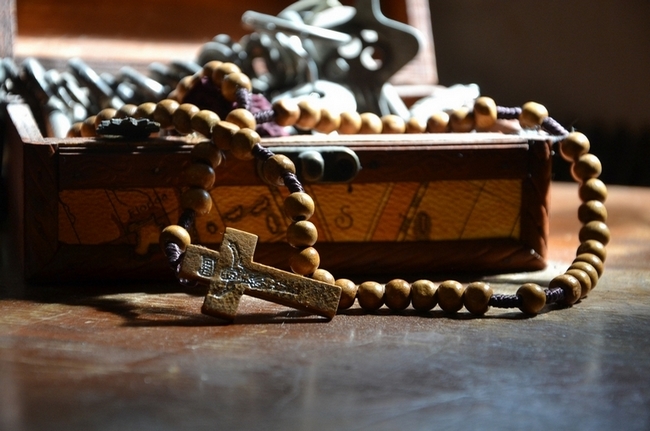
Outside of the Mass, this is perhaps the commonest set of Catholic devotional prayers. The word ‘Rosary’ derives from the Latin Rosarium , that is a Rose. This links to Mary, as she is sometimes known as the ‘Mystical Rose’. The Rosary is seen as a meditation on the life of Christ, using portions of scripture for meditation.
To begin the Rosary, it is common to use the Apostles Creed:
I believe in God, the Father Almighty, Creator of heaven and earth; and in Jesus Christ, His only Son, our Lord: Who was conceived by the Holy Spirit, born of the Virgin Mary; suffered under Pontius Pilate, was crucified, died and was buried. He descended into hell; the third day He rose again from the dead; He ascended into heaven, is seated at the right hand of God the Father Almighty; from thence He shall come to judge the living and the dead. I believe in the Holy Spirit, the Holy Catholic Church, the communion of Saints, the forgiveness of sins, the resurrection of the body, and life everlasting. Amen.
The Lord’s prayer is also used in the Rosary, and the main prayer is called the ‘Hail Mary’:
Hail Mary, full of Grace, the Lord is with thee. Blessed art thou among women and blessed is the fruit of thy womb, Jesus. Holy Mary, Mother of God, pray for us sinners now and at the hour of our death. Amen.
The Hail Mary is repeated 10 times, forming a ‘Decade’ and there are 15 Decades in total. These 15 are then subdivided into ‘Mysteries’:
- Joyful – The Annunciation and birth of Jesus.
- Sorrowful – Jesus’ suffering and death.
- Glorious – Including Jesus’ Resurrection and Ascension and Mary’s Assumption.
In 2002, Pope John Paul II (1920-2005), introduced another set called the Luminous mysteries, which focus attention on five major events in Jesus life. These include Jesus’ Baptism and also the Transfiguration.
Normally, a string of beads (as shown above) is commonly used when reciting the Rosary, the beads being used as an aide-de-memoir. Normal practice is to recite only one mystery at a time rather than the whole twenty.
Apart from the Rosary, there are other prayers (known as Chaplets) that may be prayed to Mary, other saints or indeed to Christ himself. A well-known chaplet is known as the Divine Mercy, a series of prayers revealed by Jesus to a Polish nun named Saint Faustina (1905-1938). These are intended to stress the mercy of God toward repentant sinners:
“Eternal Father, I offer you the Body and Blood, Soul and Divinity of Your Dearly Beloved Son, Our Lord, Jesus Christ, in atonement for our sins and those of the whole world.”
Also popular is devotion to the ‘Sacred Heart’ of Jesus, symbolically representing his love for all mankind. This devotion dates from at least the 13th century.
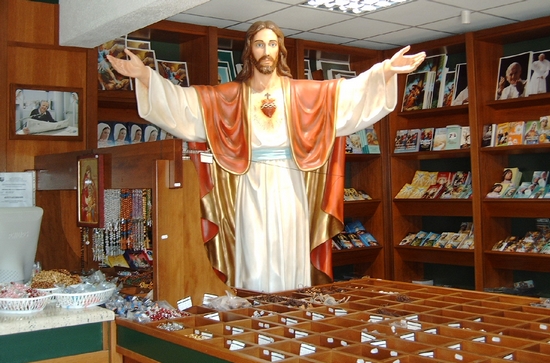
A Sacred Heart statue, as shown in a Medjugorje gift shop.
Marian Apparitions
Throughout history, it has been claimed that Mary has appeared to numerous individuals. Perhaps the most famous being that at Lourdes (see below). Most recently there are those at Medjugorje, a small village in Croatia. A group of young children first received messages from Mary in 1981, and some of them still claim to do so today. Common phenomena visitors to Medjugorje report include seeing a rapidly spinning sun and a Host (i.e. the Eucharistic bread) appear from it. The Catholic church seeks to authenticate such sightings by undertaking a detailed investigation, and several alleged apparitions have not been approved. At this time, Medjugorje still remains under investigation.
Those that have been declared valid apparitions include:
- Walsingham (Norfolk, UK) – In 1061 a Saxon noblewoman named Richeldis de Faverches had a vision in which the Blessed Virgin appeared and asked her to build a replica of Nazareth. The original shrine was destroyed during the reign of Henry VIII and two new shrines (one Anglican, the other Roman Catholic) were built in the 20th century.
- Lourdes (France) – In 1858 the Blessed Virgin appeared to a young peasant girl named Bernadette Soubirous proclaiming “I am the immaculate conception”. Lourdes has a grotto with spring water that is said to have healing properties and several healings have been reported, investigated medically, and accepted by the Church.
- Fatima (Portugal) – In 1917 three children received monthly visitations from Mary. The Children were asked to recite the Rosary regularly, it being a key method to bring world peace (at that time fighting was occuring during World War I). The children were given three secrets: The first being a vision of hell and the second instructions to bring world peace, particularly through the consecration of Russia. The third secret has attracted much attention and was not revealed by the church until 2000. Some have seen it as pointing to the attempted assassination of the then Pope, John Paul II in 1981:
“After the two parts which I have already explained, at the left of Our Lady and a little above, we saw an Angel with a flaming sword in his left hand; flashing, it gave out flames that looked as though they would set the world on fire; but they died out in contact with the splendor that Our Lady radiated towards him from her right hand: pointing to the earth with his right hand, the Angel cried out in a loud voice: ‘Penance, Penance, Penance!’. And we saw in an immense light that is God: ‘something similar to how people appear in a mirror when they pass in front of it’ a Bishop dressed in White ‘we had the impression that it was the Holy Father’. Other Bishops, Priests, men and women Religious going up a steep mountain, at the top of which there was a big Cross of rough-hewn trunks as of a cork-tree with the bark; before reaching there the Holy Father passed through a big city half in ruins and half trembling with halting step, afflicted with pain and sorrow, he prayed for the souls of the corpses he met on his way; having reached the top of the mountain, on his knees at the foot of the big Cross he was killed by a group of soldiers who fired bullets and arrows at him, and in the same way there died one after another the other Bishops, Priests, men and women Religious, and various lay people of different ranks and positions. Beneath the two arms of the Cross there were two Angels each with a crystal aspersorium in his hand, in which they gathered up the blood of the Martyrs and with it sprinkled the souls that were making their way to God.”
» Please visit the Walsingham and Medjugorje pages for pictures of the shrines.
» View the Walsingham Chronology.
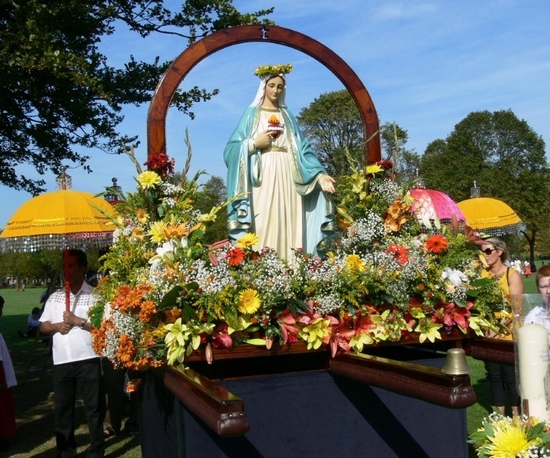
Marian Procession: Manchester, UK, 2011.
 Doctors of the Church
The appellation ‘Doctor of the Church’ is bestowed upon saints whose writings and teachings are held to be of special benefit for the church as a whole. Individuals are normally given this title by a serving Pope, though they may also be given it at an ecumenical council.
| Doctors of the Church | ||
|---|---|---|
| Name | Title Bestowed | Summary |
| St. Albert the Great (1193-1280) |
Universal Doctor | German Dominican Bishop who encouraged the study of natural science. |
| St. Alphonsus Liguori (1696-1787) |
Doctor Most Zealous | Italian patron saint of confessors and moralists. |
| St. Ambrose (c. 340-397) |
– | Bishop of Milan who opposed the Arian heresy. |
| St. Anselm (1033-1109) |
Magnificent Doctor | Italian who became Archbishop of Canterbury and founder of Scholasticism. Developed the ontological argument for the existance of God. |
| St. Anthony of Padua (1195-1231) |
Evangelizing Doctor | Portugese Franciscan Priest known for his powerful preaching. |
| St. Athanasius (298-373) |
– | Bishop of Alexandria and opponent of Arianism. |
| St. Augustine of Hippo (354-430) |
Doctor of Grace | Dominant theologian in Western Christianity prior to Thomas Aquinas. |
| St. Basil of Caesarea (330-379) |
– | Also known as Basil the Great. Theologian and monk who opposed Arianism. |
| St. Bede the Venerable (672-735) | – | English Monk who compiled The Ecclesiastical History of the English People. |
| St. Bernard of Clairvaux (1090-1153) |
Mellifluous Doctor | French Cistercian Abbot who contributed to the reform of the order. |
| St. Bonaventure (1221-1274) |
Seraphic Doctor | Italian Franciscan Theologian. |
| St. Catherine of Siena (1347-1380) |
– | Dominican mystic and theologian. |
| St. Cyril of Alexandria (376-444) |
Doctor of the Incarnation | Patriarch of Constantinople. Made significant contributions to Christology. |
| St. Cyril of Jerusalem (315-386) |
– | Bishop and opponent of Arianism. |
| St. Ephrem (306-373) |
– | Syrian hymn writer, poet and theologian. |
| St. Francis de Sales (1567-1622) |
Doctor of Charity | French Bishop of Geneva, writer of spiritual works most notably Introduction to the Devout Life. |
| St. Gregory the Great (c. 540-604) |
– | Pope who defended papal supremacy and undertook many reforms. |
| St. Gregory of Nazianzus (329-389) |
– | Archbishop of Constantinople. Made significant contributions to trinitarian theology. |
| St. Hilary of Potiers (300-367) |
– | French Bishop, known as the ‘Athanasius of the West’. |
| St. Hildegard of Bingen (1098-1179) |
– | Benedictine abbess, composer and mystic. |
| St. Isidore (560-636) |
– | Archbishop of Seville and church historian and theologian. |
| St. Jerome (c. 347-420) |
– | Translated the Bible into Latin (The Vulgate). |
| St. Gregory of Narek (951-1003) |
Monk, poet, mystical philosopher, theologian | |
| St. John of Avila (1500-1569) |
– | Priest and Mystic |
| St. John Chrysostom (347-607) |
– | Archbishop of Constantinople, famous for his preaching (Chrysostom means ‘Golden-mouthed’). |
| St. John Damascene (676-749) |
– | Syrian hymn writer, poet and theologian. |
| St. John of the Cross (1542-1591) |
Mystic Doctor | Spanish mystic who played a major role during the counter-reformation. |
| St. Lawrence of Brindisi (1559-1619) |
Apostolic Doctor | Portugese Capuchin Priest who helped further the counter-reformation. |
| St. Leo the Great (400-461) |
– | Pope, famous for his Tome, a statement of orthodox christology. |
| St. Peter Canisius (1521-1597) |
– | Dutch Jesuit who assisted in the counter reformation. |
| St. Peter Chrysologus (406-450) |
– | Italian Bishop, known for his preaching (Chysoslogus means ‘Golden-worded’). |
| St. Peter Damian (1007-1072) |
– | Italian reforming monk and Cardinal. |
| St. Robert Bellarmine (1542-1621) |
– | Italian Jesuit Cardinal. |
| St. Teresa of Avila (1515-1582) |
– | Spanish carmelite nun and mystic. Writer of the spiritual work The Interior Castle. |
| St. Therese of Lisieux (1873-1897) |
Doctor of Love | French Carmelite Nun who developed the ‘Little Way’ of Holiness. |
| St. Thomas Aquinas (1225-1274) |
Angelic Doctor/Common Doctor | Scholastic philosopher and theologian. Writer of the great work of systematic theology: summa theologiae. Patron saint of education. |
More information:
Here is a selected series of links that will give more information:
Catholic online – list of saints | Medjugorje – Wikipedia | Saints alive – authentic relics | The Divine Mercy chaplet |

 More information: