The Papacy lies at the heart of Catholic belief and doctrine. In this section, we’ll look at how the Papacy works and how the Pope exercises authority today.
You are here: » Christianity in View » Introduction to Roman Catholicism » The Papacy
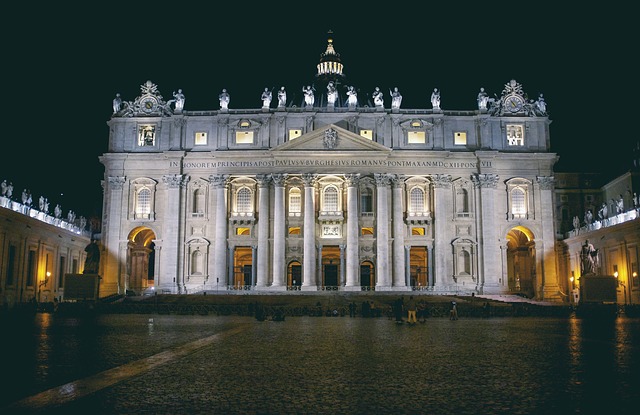
The Vatican, Rome by night
 Origins of the Papacy
The beginnings of the Papacy (From the Greek Pappas : ‘Father’) may be traced to Christ’s words to Peter:
“And I say to thee: That thou art Peter; and upon this rock I will build my church, and the gates of hell shall not prevail against it. And I will give to thee the keys of the kingdom of heaven. And whatsoever thou shalt bind upon earth, it shall be bound also in heaven: and whatsoever thou shalt loose on earth, it shall be loosed also in heaven.”
Matthew 16:18-19 (DRB)
Deriving from Matthew 16:19 is the doctrine of the Power of the keys, that is Christ’s words to Peter assert supreme authority over the church. The phrase “Binding and loosing” (also found in Matthew 18:18, where Christ is talking to the apostles), is taken to refer to church authority:
“The power to bind and loose connotes the authority to absolve sins, to pronounce doctrinal judgements, and to make disciplinary decisions in the Church. Jesus entrusted this authority to the Church through the ministry of the apostles and in particular through the ministry of Peter, the only one to whom he specifically entrusted the keys of the kingdom.”
Paragraph 553, CCC.
The Pope is sometimes known as the ‘Vicar of Christ’, the word Vicar coming from the Latin word for ‘Substitute’, i.e. the Pope is the visible representative of Christ on earth. Part of the Papal function lies within the Magisterium, that is the supreme authority of the Roman Catholic Church to interpret scripture and teach it. In the section ‘The Church’ we will look at this in more detail.
“The Pope, Bishop of Rome and Peter’s successor, is the perpetual and visible source and foundation of the unity both of the bishops and of the whole company of the faithful. For the Roman Pontiff, by reason of his office as Vicar of Christ, and as pastor of the entire Church has full, supreme, and universal power over the whole Church, a power which he can always exercise unhindered.”
Paragraph 882, CCC.
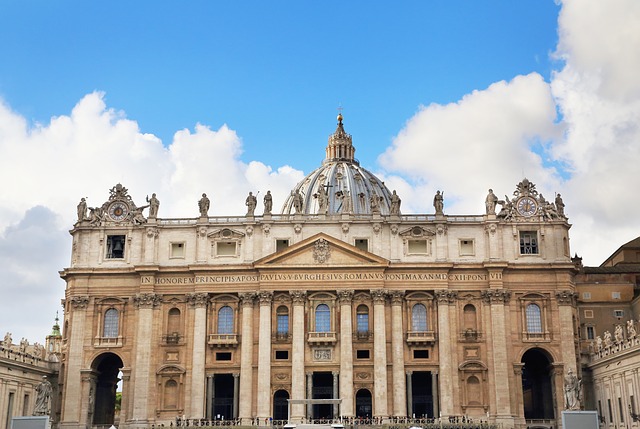
The Papacy in History
In the early church Rome (along with Alexandria and Antioch) was regarded as a Patriarchate, i.e. an autonomous diocese. To this group was added the patriachates of Constantinople and Jerusalem in the fifth century. This group of five was regarded as having supreme authority in the church as a whole. However, historical events (e.g. the firm tradition that Peter and Paul had been martyred in Rome) led some to regard the Bishop of Rome as First among equals, i.e. his was a primacy of honour, rather than of jurisdiction.
Over time, the claims of the Bishop of Rome to be regarded as the supreme Patriarch became greater. From the beginning this was disputed, but Pope Leo I (d. 461) brought the issue to the forefront. His Tome, a vigorous defence of Orthodox Christian belief, did much to strengthen the case for papal supremacy.
Pope Gregory I (c.540-604) went further and asserted the primacy of the Papacy, using the title servus servorum Dei i.e. ‘servant of the servants of God.’
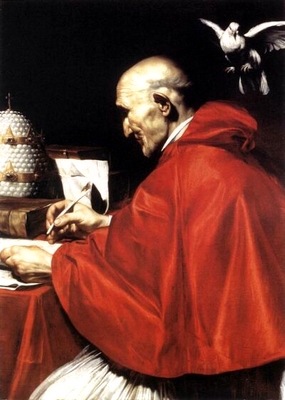
Pope Gregory I
Portrait by Carlo Saraceni (1579-1620).
The growing papal claims along with several other issues* eventually led to the ‘Great Schism’ of 1054, in which the Western church (Catholic), separated from the Eastern church (Orthodox). Further information on this is found in the Introduction to the Orthodox church.
* Most notably the addition of the Filioque (Latin: ‘and the son’) to the Nicene creed, indicating that the Holy Spirit proceeds from both the Father and the Son.
In 1095, Pope Urban II authorised the First Crusade, an attempt to militarily recapture the Holy Land, which at that time was under Islamic control. The Crusades continued on and off until 1272 and met with limited success. The sack of Constantinople in 1204 during the fourth crusade only served to increase the tension between Eastern and Western Christianity.
In the 13th century, the church experienced a renewal movement in the monastic ideal. Pope Honorius III approved the creation of two of Catholicism’s greatest religious orders: The Dominicans (in 1216) and the Franciscans (in 1223).
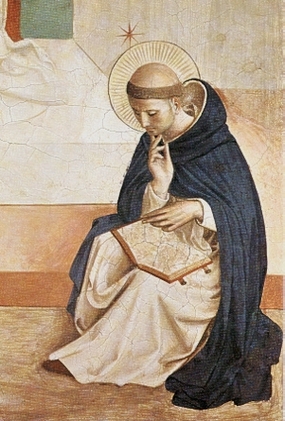
St. Dominic (1170-1221)
Portrait by Fra Angelico (1395-1455).
In the 14th century there was a dispute between Pope Boniface VII and Philip IV of France over papal authority. The dispute led eventually to the Papal throne being moved to the French town of Avignon in 1305. This situation lasted until 1377, when at the behest of St. Catherine of Siena (1347-1380), Pope Gregory XI moved it back to Rome. Gregory’s death in 1378 resulted in a schism over two rival claimants for the Papacy – one French, the other Italian.
Because of the perceived weakness of papal authority, the ‘conciliar theory’ developed i.e. the idea that the Pope was subordinate to a church council and thus the church could be governed by the consent of the college of bishops. The schism ended in 1417, when Pope Martin V was elected. Later the conciliar theory was rejected by the council of Florence (1438-45), which upheld papal supremacy.
The start of the Reformation on 31 October 1517 presented a new challenge to the Papacy. The church launched its own ‘Counter-Reformation’ and Pope Paul III began the Council of Trent (1545-1563), which addressed the complaints of the Reformation leaders and clarified Catholic teaching. In 1566 the church published the definitive Catechism (‘Instruction’) which gave a clear exposition of Catholic teaching on all matters of faith and practice. This Catechism remained in use for over 400 years, until Pope John Paul II (1920-2005) published a revised version in 1992.
As well as exerting spiritual power, the Papacy was able to exercise temporal authority over part of Italy in what were known as the ‘Papal States’. Italy was unified by popular consent in 1870 and Papal control was restricted to Rome only. Finally, in 1929, the Lateran treaty was signed between the Italian government and the Pope. It created the Vatican City, a wholly independent state within Rome.
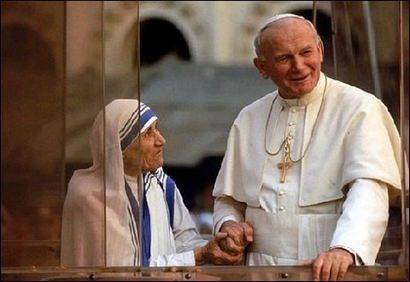
Mother Teresa of Calcutta (1910-1997) and John Paul II (1920-2005).
Papal Infallibility
This was first proclaimed in 1870 as a dogma (i.e. a divinely revealed truth), though the view itself was held by some before that.
“The Roman Pontiff, head of the college of bishops, enjoys this infallibility in virtue of his office, when, as supreme pastor and teacher of all the faithful – who confirms his brethren in the faith he proclaims by a definitive act a doctrine pertaining to faith or morals… The infallibility promised to the Church is also present in the body of bishops when, together with Peter’s successor, they exercise the supreme Magisterium, above all in an Ecumenical Council. When the Church through its supreme Magisterium proposes a doctrine for belief as being divinely revealed, and as the teaching of Christ, the definitions must be adhered to with the obedience of faith. This infallibility extends as far as the deposit of divine Revelation itself.”
Paragraph 891, CCC.
This declaration does not imply that the Pope is without sin, but rather that any pronouncements he makes on faith and morals and made ex cathedra, that is from his position as leader of the church, are divinely revealed and binding on all Catholics. In 1950, Papal infallibility was used to proclaim the Catholic belief in Mary’s assumption into heaven.
Furthermore, the declaration is retrospective i.e. previous Papal pronouncements may be regarded as infallible if they meet the criteria specified above. Thus the 1854 declaration of the Immaculate Conception of Mary is accepted in this manner.
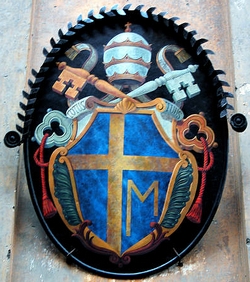
The Papal Coat of Arms of John Paul II (1920-2005).
The Current Pope – Francis
On 13 March 2013, Jorge Mario Bergoglio was elected Pope, replacing Benedict XVI (see below).
Facts about Pope Francis
- Aged 76, he was born in Buenos Aires on December 17, 1936, one of five children of an Italian immigrant railway worker.
- He entered the Society of Jesus in 1958. He was the provincial for Argentina from 1973 to 1979.
- He was ordained a priest in 1969 and a bishop in 1992, and was made a cardinal in 2001.
- He is the first Jesuit ever to be pope and the first non-European pope since Pope Gregory III (AD 731-741).
- He is the first pope from the Americas, and the first pope from the southern hemisphere.
- He is the first pope to introduce a new single papal name in over 1,000 years.
- In 2001 he visited a hospice to kiss and wash the feet of 12 AIDS patients.
Source: Catholic Herald
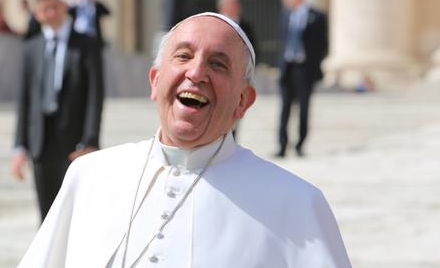
Pope Francis (1936-).
“The Eucharist is the sacrament of the communion that takes us out of our individualism so that together we live our discipleship, our faith in him and it is not a prize for the perfect but a powerful medicine and nourishment for the weak.”
Pope Francis (1936-).
The Previous Pope – Benedict XVI
On 19 April 2005, Cardinal Joseph Ratzinger was elected the 265th Pope of the Roman Catholic Church. He took the title Benedict XVI (The word means ‘Blessed’).
Joseph Alois Ratzinger was born in Bavaria, Germany on 16 April 1927. Ordained a priest in 1951, he later become a professor at several German universities. He gained a reputation as a prolific writer and eminent theologian and attended the second Vatican council (1962-5) as a peritus or theological adviser. In 1981 he was appointed to the prefecture of the ‘Congregation for the Doctrine of the Faith’, a department within the Catholic church dealing with doctrine and church discipline. His inaugural mass as Pope was celebrated on 24 April 2005 and early in 2006, his first encyclical: Deus caritas est (God is love) was published.
On 11th February 2013, Benedict XVI announced his decision to step down from the papacy, effective from 28th February. Pope Benedict’s decision made him the first Pope to resign since Pope Gregory XII in 1415.
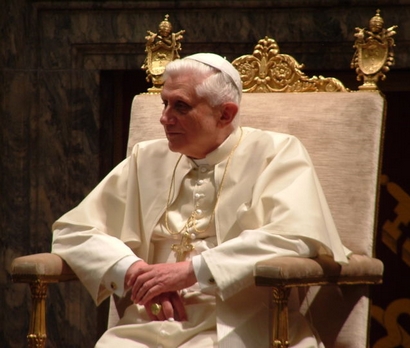
Pope Benedict XVI (1927-).
More information:
Here is a selected series of links that will give more information:
Catholic Encyclopedia – The Pope | Vatican offical website | Vatican picture gallery | Wikipedia – Pope Francis
Wise words:
“[I am]…a simple, humble worker in the vineyard of the Lord…”
Pope Emeritus Benedict XVI (1927-)
Vatican crest:
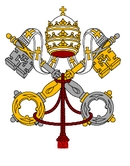
The crest above consists of the crossed keys of Saint Peter with the papal tiara above.
St Peter:
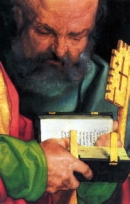
St. Peter, by Albrecht Durer (1471-1528).