You are here: » Christianity in View » Introduction to Roman Catholicism » Home Page
 Page Navigation:
Catholic Statistics | Downloads | Comparing Catholicism, Orthodoxy & Protestantism | The Church & Ecumenism | Christian Traditions

“If thou bear the cross cheerfully, it will bear thee.” – Thomas A’ Kempis.
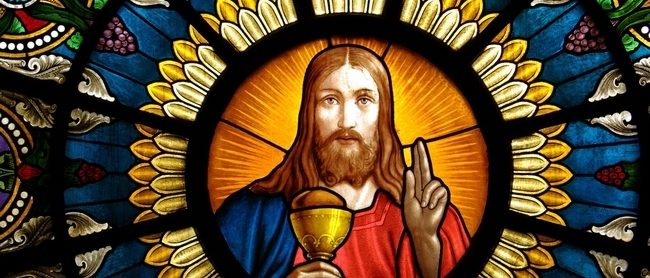 The Saviour : Christ - He humbled himself, becoming obedient unto death, even to the death of the cross. (Philippians 2:8)
 A personal word
A warm welcome to this web site, part of the Christianity in View series of websites, which examine the Christian Faith.
This web site focuses on the essential beliefs and practices of the Roman Catholic Church*, the largest tradition within Christendom. The word ‘Catholic’ comes from the Greek phrase καθολου (kath’holou ), meaning ‘concerning the whole’. The word ‘Catholic’ can also be understood in English to mean ‘universal’.
* Officially called the ‘Catholic Church’.
 Vote for your favourite Catholic.
Complete a Survey designed for Roman Catholic Christians.
Sources
This web site makes reference to official documents such as Papal Encyclicals and the Catechism of the Catholic Church (CCC), which is the official guide to the Church’s faith and practices. Scripture references are from the Douay-Rheims Bible (DRB). This is a translation into English of the Vulgate, the official Catholic version of the Bible, which was written in Latin. The Vulgate was translated directly from the original Greek text by St. Jerome (c. 340-420). Other versions in modern day use include the New Jerusalem Bible, New American Bible (NAB) and the popular Revised Standard Version (Catholic edition).
Let us remind ourselves of the words of Christ regarding unity:
“That they all may be one, as thou, Father, in me, and I in thee; that they also may be one in us: that the world may believe that thou hast sent me. And the glory which thou hast given me, I have given to them: that, they may be one, as we also are one.”
John 17:21-12 (DRB)
Catholic Statistics
According to the Catholic research agency, CARA (Center for Applied Research in the Apostolate), In 2014 (the last year for which statistics are available), the Roman Catholic church had, worldwide:
- 414,313 Priests (of which 279,561 are diocesan priests and 134,752 are religious priests)
- 221,740 Parishes
- 42,104 Permanent Deacons
- 55,314 Religious brothers and 705,529 religious sisters
- 1,229 million adherents making up 17% of the world population.
Additional Statistics
The Catholic population of England and Wales.
The Catholic population of Europe.
Statistics from the Pontifical Yearbook for 2016.
Key Findings
- From 1970 to 2014, the Roman Catholic Population worldwide grew from 653.6 million to 1,229 million, roughly matching the overall population growth during this period.
- From 1965 to 2014, it grew from 45.6 million to 66.6 million in the USA (According to the Official Catholic Directory for parish connected Catholics)
- The US total of 17,464 for Permanent Deacons in 2014 was 41.5% of the worldwide total of 42,104.
- In 2014, 24% of Catholics surveyed in the US attended Mass every week, an increase of 2% since 2000, but a fall of 31% since 1965.
Downloads
Also available on this website are a number of resources in PDF format giving a summary of Catholic teaching and practice:
- Abortion
- Catholic Prayers I
- Catholic Prayers II
- Human Sexuality
- Missale Romanum (1920)
- The Divine Mercy Chaplet
- The Order of the Mass (In English)
- The Rosary
- The Seven Sacraments
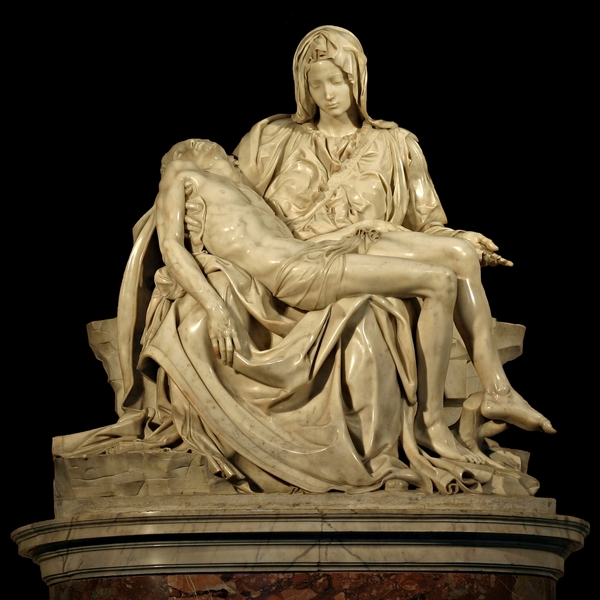
Pieta, by Michelangelo (1475-1564), St. Peter’s Basilica, Rome.
The Virgin Mary mourns the death of Christ.
Comparing Catholic, Orthodox and Protestant beliefs
A detailed article on the differences between the Catholic and Orthodox churches is given by the Orthodox Church in America (OCA).
Of particular interest to many is the comparison of the Catholic faith in comparison to Protestantism, which has five foundational principles known as solae (Latin: ‘alone’).
1. Sola Gratia (Grace Alone)
PROTESTANT VIEW
Salvation is the free gift of God to man. It is obtained by God’s Grace alone and not through any merit on the part of the Christian.
GRACE = God’s Riches At Christ’s Expense.
“For by grace you are saved through faith: and that not of yourselves, for it is the gift of God. Not of works, that no man may glory.”
Ephesians 2:8-9 (DRB).
CATHOLIC VIEW
In Catholic doctrine, Salvation is obtained by God’s Grace through faith; faith which is active, not passive. Salvation is through the grace of God which is “infused” into us. This grace is freely given, but men and women are responsible for co-operating with it. Primarily, this is done through participation in the Sacraments, which are seen as channels of grace. This grace of salvation (known as sanctifying grace) can be lost through committing mortal sin, but regained through the Sacrament of Reconciliation or Penance, which involves confession, repentance and forgiveness.
“Not every one that saith to me, Lord, Lord, shall enter into the kingdom of heaven: but he that doth the will of my Father who is in heaven, he shall enter into the kingdom of heaven.”
Matthew 7:21 (DRB).
“The grace of Christ is the gratuitous gift that God makes to us of his own life, infused by the Holy Spirit into our soul to heal it of sin and to sanctify it. It is the sanctifying or deifying grace received in Baptism. It is in us the source of the work of sanctification: Therefore if any one is in Christ, he is a new creation; the old has passed away, behold, the new has come. All this is from God, who through Christ reconciled us to himself.”
Paragraph 1999, CCC.
2. Sola Fide (Faith Alone)
PROTESTANT VIEW
We are judged righteous in the sight of God purely on the basis of our faith. The atoning sacrifice of Christ leads to righteousness being imputed to us as sinners through a legal declaration by God. This is often stated as Justification by faith alone. There is a clear distinction between Justification and Sanctification, the latter being the growth in holiness arising from the work of the Holy Spirit in the Christian.
FAITH = Forsaking All I Trust Him.
“But that in the law no man is justified with God, it is manifest: because the just man liveth by faith.”
Galatians 3:11 (DRB).
CATHOLIC VIEW
As with Grace, the Catholic view is that good works accompanied by our faith, form the basis for our justification.
“For even as the body without the spirit is dead: so also faith without works is dead.”
James 2:26 (DRB).
Justification is a process in which we grow in grace and perform good works acceptable to God, rather than a once only event. Thus in Catholicism, Justification includes not only God’s action in declaring us righteous, but also the process of making us so. Therefore sanctification is part of justification:
“Like conversion, justification has two aspects. Moved by grace, man turns toward God and away from sin, and so accepts forgiveness and righteousness from on high. Justification includes the remission of sins, sanctification, and the renewal of the inner man.”
Paragraphs 2018-9, CCC.
3. Solus Christus (Christ Alone)
PROTESTANT VIEW
Christ is the one Mediator between God and man and our salvation is accomplished only through His death and resurrection.
“For there is one God: and one mediator of God and men, the man Christ Jesus.”
1 Timothy 2:5 (DRB).
CATHOLIC VIEW
Catholicism accepts Christ’s sole mediatorship between God and Man, but it argues that this does not exclude secondary mediatorships that are subordinated to Christ. On this basis, the saints (including Mary) can act as mediators.
“And another angel came and stood before the altar, having a golden censer: and there was given to him much incense, that he should offer of the prayers of all saints, upon the golden altar which is before the throne of God. And the smoke of the incense of the prayers of the saints ascended up before God from the hand of the angel.”
Revelation 8:3-4 (DRB).
Mediatorship can also take the form of that exercised by the priesthood. For example, a validly ordained Priest can celebrate the Mass, which, as a Sacrament acts as a vehicle for the dispensation of Grace.
Like Protestants, Roman Catholics affirm the doctrine of the Priesthood of all Believers, on the basis of 1 Peter 2:9:
“But you are a chosen generation, a kingly priesthood, a holy nation, a purchased people: that you may declare his virtues, who hath called you out of darkness into his marvelous light.”
1 Peter 2:9 (DRB).
However, the Catholic view is that there also exists a special or “ministerial” priesthood, which has its roots in the Biblical priesthood outlined in the Old Testament. Thus ordained priests are able to offer sacrifices to God (especially the Sacrifice of the Mass) and absolve people of sins (through the Sacrament of Reconciliation).
“That I should be the minister of Christ Jesus among the Gentiles: sanctifying the gospel of God, that the oblation of the Gentiles may be made acceptable and sanctified in the Holy Ghost.”
Romans 15:16 (DRB).
4. Sola Scriptura (Scripture Alone)
PROTESTANT VIEW
Scripture alone is the only infallible source of divine revelation and the final authority for matters of faith and practice. Sola Scriptura does not mean that all truth is contained in the Bible, rather that all we need to know for salvation is contained within it.
“All scripture, inspired of God, is profitable to teach, to reprove, to correct, to instruct in justice. That the man of God may be perfect, furnished to every good work.”
2 Timothy 3:16-17 (DRB).
CATHOLIC VIEW
The Catholic view is that alongside Sacred Scripture, Sacred Tradition (that is, those teachings which have been handed down from the Apostles) constitutes divine revelation. Interpretation of this revelation has been entrusted to the Catholic church through the magisterium or teaching authority that it possesses. This it is claimed, was given to it by Christ himself.
“This living transmission, accomplished in the Holy Spirit, is called Tradition, since it is distinct from Sacred Scripture, though closely connected to it. Through Tradition, the Church, in her doctrine, life and worship, perpetuates and transmits to every generation all that she herself is, all that she believes. The sayings of the holy Fathers are a witness to the life-giving presence of this Tradition, showing how its riches are poured out in the practice and life of the Church, in her belief and her prayer.”
Paragraph 78, CCC.
“Therefore, brothers, stand firm and hold fast to the traditions that you were taught, either by an oral statement or by a letter of ours.”
2 Thessalonians 2:15 (DRB).
The Pope as the visible head of the Church on earth, and the successor of Peter, acts with the authority given to him directly by Christ in Matthew 16:18. Scripture and Tradition together form the fidei depositum – the sacred deposit of faith.
5. Soli Deo Gloria (To the Glory of God Alone)
PROTESTANT VIEW
Every aspect of the Christian life is to be seen as giving glory to God. This was a reaction to the honour given to the Papacy and the saints and in effect, underlies the other four Soli above.
“If any man speak, let him speak, as the words of God. If any minister, let him do it, as of the power which God administereth: that in all things God may be honoured through Jesus Christ: to whom is glory and empire for ever and ever. Amen.”
1 Peter 4:11 (DRB).
CATHOLIC VIEW
The Papacy and Mary and the Saints are discussed on this web site.
» This website also has a Quiz, which compares Protestant and Catholic theology.
» Also available is a Comparison table between Orthodoxy, Protestantism and Catholicism.
The Church and Ecumenism
The traditional Catholic view is often expressed in the Latin phrase Extra Ecclesiam nulla salus or ‘Outside the church there is no salvation’. Salvation is in Christ as the head of the Church, but through the Church itself which is his body. This doctrine has been expressed at various times throughout the history of the church, for example:
“There is but one universal Church of the faithful, outside which no one at all is saved.”
Lateran IV Council (1215)
“…Basing itself on Scripture and Tradition, the Council teaches that the Church, a pilgrim now on earth, is necessary for salvation: the one Christ is the mediator and the way of salvation; he is present to us in his body which is the Church. He himself explicitly asserted the necessity of faith and Baptism, and thereby affirmed at the same time the necessity of the Church which men enter through Baptism as through a door. Hence they could not be saved who, knowing that the Catholic Church was founded as necessary by God through Christ, would refuse either to enter it or to remain in it.”
Paragraph 846, CCC.
Although the church is necessary for salvation, those outside of its visible structure may also achieve salvation:
“This affirmation is not aimed at those who, through no fault of their own, do not know Christ and his Church: Those who, through no fault of their own, do not know the Gospel of Christ or his Church, but who nevertheless seek God with a sincere heart, and, moved by grace, try in their actions to do his will as they know it through the dictates of their conscience – those too may achieve eternal salvation.”
Paragraph 847, CCC.
The second Vatican council which was held from 1962-5, demonstrated the commitment of the Catholic church to engage in building closer relations with the rest of Christendom. Pope Paul VI set up the Secretariat for Promoting Christian Unity (now called the Pontifical Council for Promoting Christian Unity) as a permanent department devoted to dialogue with other Christians.
The Vatican’s decree on ecumenism: Unitatis redintegratio, was proclaimed by Paul VI in 1964. This was a significant step forward in ecumenical relations. The extracts below (bold type added) bear this out:
“…In recent times more than ever before, he [Christ the Lord] has been rousing divided Christians to remorse over their divisions and to a longing for unity. Everywhere large numbers have felt the impulse of this grace, and among our separated brethren also there increases from day to day the movement, fostered by the grace of the Holy Spirit, for the restoration of unity among all Christians. This movement toward unity is called ‘ecumenical.’ “
“…Even in the beginnings of this one and only Church of God there arose certain rifts, which the Apostle strongly condemned. But in subsequent centuries much more serious dissensions made their appearance and quite large communities came to be separated from full communion with the Catholic Church for which, often enough, men of both sides were to blame.”
“The children who are born into these Communities and who grow up believing in Christ cannot be accused of the sin involved in the separation, and the Catholic Church embraces upon them as brothers, with respect and affection. For men who believe in Christ and have been truly baptized are in communion with the Catholic Church even though this communion is imperfect. The differences that exist in varying degrees between them and the Catholic Church …do indeed create many obstacles, sometimes serious ones, to full ecclesiastical communion. …But even in spite of them it remains true that all who have been justified by faith in Baptism are members of Christ’s body, and have a right to be called Christian, and so are correctly accepted as brothers by the children of the Catholic Church…“
The implications of this are that Protestants and other non-Catholic Christians are regarded as ‘Separated Brethren’, sharing a common baptism with the Catholic Church, but also being in imperfect communion with it.
The second Vatican council also published a document named Lumen Gentium (Light to the Nations), which discussed the issue of how the Catholic church relates to other churches.
“This is the sole church of Christ which in the Creed we profess to be one, holy, catholic and apostolic, which our Savior, after his resurrection, entrusted to Peter’s pastoral care (John. 21:17), commissioning him and the other apostles to extend and rule it (cf. Matthew. 28:18, etc.), and which he raised up for all ages as “the pillar and mainstay of the truth” (1 Tim. 3:15). This Church, constituted and organized as a society in the present world, subsists in the Catholic Church, which is governed by the successor of Peter and by the bishops in communion with him.”
“Nevertheless, many elements of sanctification and of truth are found outside its visible confines. Since these are gifts belonging to the Church of Christ, they are forces impelling towards Catholic unity.”
In other words, the original church of Jesus Christ dwells in the Catholic church, but other Christian churches are also to some degree part of this church and can be instruments of salvation insofar as they possess elements of the truth.
Building on Vatican II, 1994 saw the signing of Evangelicals and Catholics Together, a framework document to move toward a much closer understanding between the two groups. The full text of the ECT accord may be viewed here.
Also of note is the article: ‘My respect for Protestants’ by a former Protestant, now Catholic (Dave Armstrong). Both are found in the ‘More information’ section. I have also written a reply to Dave’s article entitled “My Respect For Catholics” which you will find in the conclusion to this web site.
In 1995, Pope John Paul II published the encyclical Ut Unum Sint (Latin: ‘may they be one’). In it, the Catholic church reiterated its desire for closer relations with the other branches of Christianity and also outlined five important subjects that are considered important for doctrinal agreement.
” It is already possible to identify the areas in need of fuller study before a true consensus of faith can be achieved:
1) the relationship between Sacred Scripture, as the highest authority in matters of faith, and Sacred Tradition, as indispensable to the interpretation of the Word of God;
2) the Eucharist, as the Sacrament of the Body and Blood of Christ, an offering of praise to the Father, the sacrificial memorial and Real Presence of Christ and the sanctifying outpouring of the Holy Spirit;
3) Ordination, as a Sacrament, to the threefold ministry of the episcopate, presbyterate and diaconate;
4) the Magisterium of the Church, entrusted to the Pope and the Bishops in communion with him, understood as a responsibility and an authority exercised in the name of Christ for teaching and safeguarding the faith;
5) the Virgin Mary, as Mother of God and Icon of the Church, the spiritual Mother who intercedes for Christ’s disciples and for all humanity.”
“The courageous witness of so many martyrs of our century, including members of Churches and Ecclesial Communities not in full communion with the Catholic Church, gives new vigour to the Council’s call and reminds us of our duty to listen to and put into practice its exhortation. These brothers and sisters of ours, united in the selfless offering of their lives for the Kingdom of God, are the most powerful proof that every factor of division can be transcended and overcome in the total gift of self for the sake of the Gospel.”
In 1999, representatives of the Roman Catholic Church and Lutheran World Foundation signed The Joint Declaration on the Doctrine of Justification, the issue of Justification being a fundamental cause of the Protestant Reformation. In 2006, the declaration was accepted by the World Methodist Council.
The following comment by the then Cardinal Joseph Ratzinger (now Pope Benedict XVI) in his book The Meaning of Christian Brotherhood should be noted:
“…In the course of a now centuries-old history, Protestantism has made an important contribution to the realization of Christian faith, fulfilling a positive function in the development of the Christian message and, above all, often giving rise to a sincere and profound faith in the individual non-Catholic Christian…”
In 2006, Benedict XVI met with the Ecumenical Patriarch (Bartholomew I), who has a position of honour as first among equals in the Orthodox church. Building on previous developments both leaders issued a Common declaration, indicating their commitment to closer co-operation.
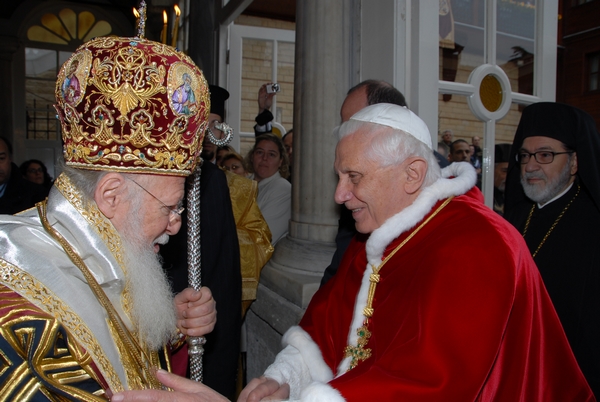
Benedict XVI and Bartholomew I in Turkey, 2006
Photo by N. Manginas
© Ecumenical Patriarchate, 2006.
A Prayer for Unity
A Personal Prayer:
“Lord, thank you for making us part of the Body of Christ. We praise you for your mercy, your goodness and your unfailing love. Throughout the ages, countless peoples have given testimony of your grace and mercy. We pray that this same grace and mercy may be given to us today. Though your church has faltered, it can never fail because you uphold it. May all of us, no matter what our individual denominational reasoning lead us to believe, serve you with openness of heart, gentleness of spirit and keenness of mind. Your prayer was that we may be one: may we strive for that oneness today, recognising our common bond as Brothers and Sisters in Christ.”
Amen
Exploring Christian Traditions
» Also available are web sites on the Protestant and Orthodox traditions of Christianity.
» A Comparison table between Orthodoxy, Protestantism and Roman Catholicism is available.
» View The Branches of Christianity
May God bless you as you read these pages.
Iain

 More information: